Pinblast Neon
Pinblast Neon blends the flashiness and satisfying feedback of pinball with precision platforming.
My roles
-
Designing, implementing, and balancing scoring system
-
Working with designers to ensure our scoring system worked with their level design to create a unified experience
-
Q/A testing

One of the first decisions our team made was we wanted a highly polished, highly replayable game with 10-15 minutes of gameplay. Having scores and rankings was a reliable way to create that replayability. Having a game that requires skill and precision to achieve high ranks also lends itself to encouraging repeat plays.
Using the familiar mechanics and visuals of pinball as a foundation we took other long standing platforming mechanics such as air dashes and grappling hooks to create the pinball platforming hybrid.
When determining a levels score thresholds I aimed for a players score to be approximately 70% time bonus, 30% environmental objects/pickup points.
To determine the appropriate time the entire team logged the fastest times they could achieve as well as the times of every outside playtester. I would take a score time from the higher end to make the "ideal" speed for an S rank.
Using these methods made the player focus on completing levels fast to get the bulk of the points, yet it was also not practical to get an S rank by completely ignoring pickups and just focusing on time. This forces high level players to find optimal paths that give you the most environmental points without sacrificing too much time, and having the skill to effectively follow that path. Thus players are pushed to always be moving forward rather then lingering in levels
Objects in the environment give the players points which is both something expected of pinball objects like bumpers, and is also a big chance for positive audio/visual feedback. However, this introduced a way for the player to exploit bumpers to gain an easy S rank. Redesigning the bumpers to remove this exploit was necessary.
After exploring other solutions such as making all objects give so insignificant amounts of points and simply removing them giving points at all, I settled on only having objects give points once. That way the player can still be rewarded for hitting them but can't exploit them for a high rank.

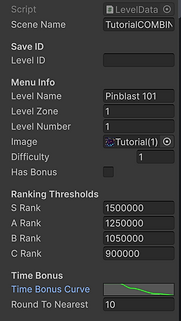
Using Unity's animation curve to determine the score a player receives allowed for easy adjustments of the following attributes
-
Maximum points
-
Delay before point bonus began decaying
-
Rate of point falloff
This allowed for rapid adjustments and easy playtesting for a smooth balancing experience
As the final deadline approached and most of my work finished I transitioned into a dedicated QA role. I tested a variety of scenarios to look for ways to go through walls, skip parts of levels, break menu navigation, or cause visual errors. If one was caused I would repeat that process multiple times to see if the bug was reproducible. Then I would note down specifics of the bug such as what caused it, if it could be replicated, and if it interfered with the player or majorly broke the game experience. Our team used Obsidian to easily track bugs and when they were fixed.